Background
On April 3, 2024, the Bay Area Air District’s (Air District) Board of Directors approved the implementation of a new community particulate matter sampling program in areas surrounding the Bay Area’s five refineries. This program aims to better understand the impacts of unplanned industrial incidents on nearby communities by measuring and characterizing larger particles associated with unplanned incidents.
The program fills a gap in the Air District’s ambient air monitoring program by sampling large particles that are not measured by other monitoring methods (e.g., PM2.5 and PM10 monitors).
The Bay Air Center, an Air District-sponsored community resource that provides technical guidance, materials, and training to Bay Area community members and organizations, supports the design and implementation of the program.
What this program does:
The program collects samples to help assess whether particles associated with an incident have traveled offsite and potentially affected surrounding communities.
What this program does NOT do:
- Map every location where fallout may have occurred
- Quantify concentrations of material in the air or soil
- Quantify the amount of material deposited over an area
This program will be designed and implemented in partnership with community members and is comprised of four components:
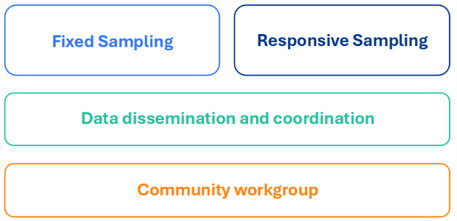
- Fixed Sampling: An Air District maintained network of fixed, continuously available, sampling locations that allow for the timely collection and laboratory analysis of deposited material following an incident.
- Responsive Sampling: Implement a flexible method for collecting particle samples in specific locations following an incident, including areas not covered by the fixed network. Samples are analyzed using the same laboratory methods as those from fixed sites, ensuring consistent and reliable results.
- Data Dissemination and Coordination: Work with community members to contextualize the data and make it available in a timely manner to communities and other agencies that have incident response roles.
- Community Workgroup: Convene a community workgroup to guide the development and implementation of the program including identification and selection of preferred sampling locations, recruitment of community members to collect particle samples during incidents, and development of methods and procedures for making the data accessible.
The workgroup consists of community members who live or work near one of the Bay Area refineries, or who represent organizations that serve these communities. Members of the workgroup address topics such as:
- Identification and selection of the preferred sampling locations for the fixed network of particle fallout samplers maintained by the Air District,
- Review and testing of protocols for community-conducted sampling,
- Recruitment of community members to collect samples after an incident occurs,
- Development of procedures for deploying community-conducted sampling after an incident occurs, and
- Development of methods and procedures for making the sampled particle fallout data publicly accessible.